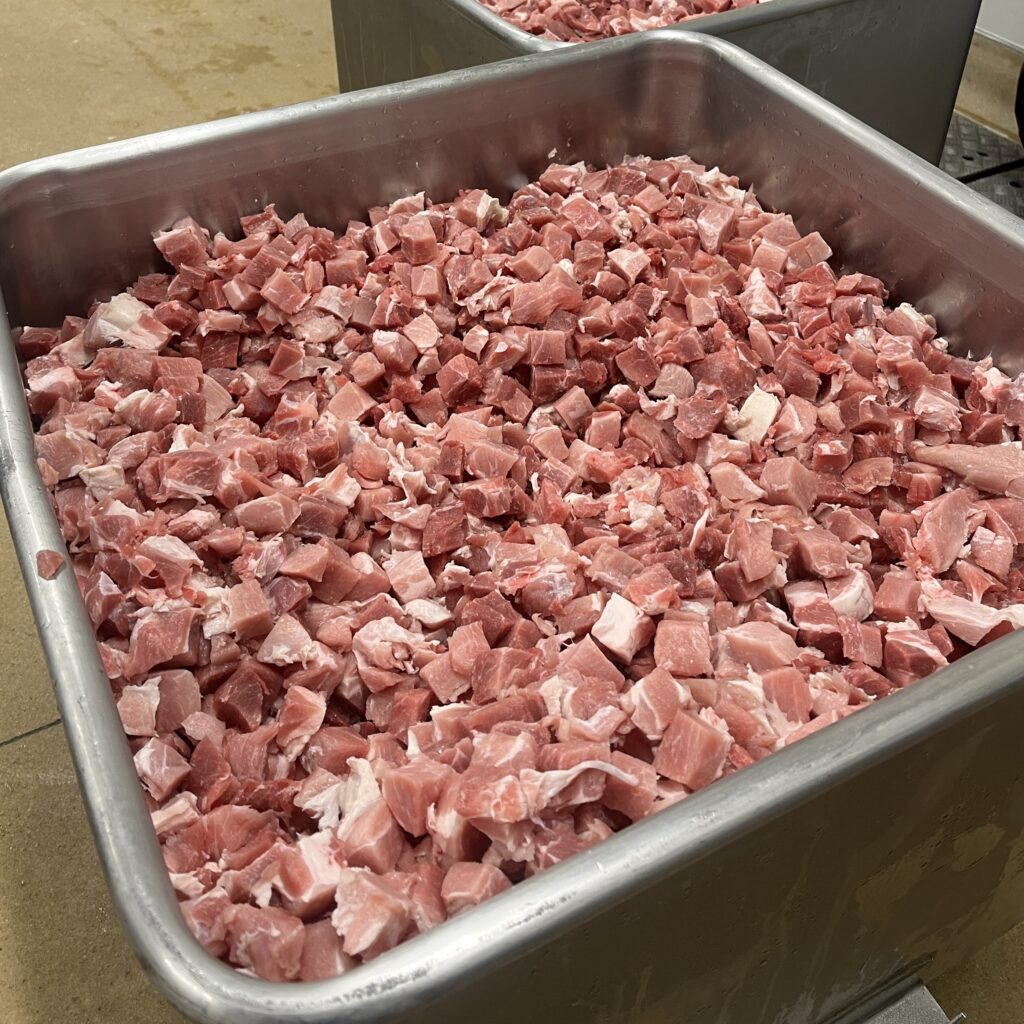
Start with a confirmed headcount, the dishes on offer and how many guests you expect to choose each one. Multiply by the served portion your kitchen has settled on to get cooked weight, then work back to a raw order using a yield you've measured yourself. Subtract usable raw stock and confirmed raw deliveries of the same specification, then order the balance.
Five numbers do most of the work
This is a volume forecast, not a costing exercise. You’re answering one question: how much raw product do we need to buy? The numbers you need are the confirmed headcount, the share of guests taking each dish, the served portion your kitchen has settled on, the overall yield from raw to served, and what you already have on hand.
Write those five down and the arithmetic is straightforward. Work from memory and you’re more likely to run short or carry product you can’t use. Costing each serve is a different job, and our guide to comparing cost per serve covers it.
A worked example, using made-up numbers
The figures below are invented to show the method. They aren’t serving recommendations, and they aren’t a yield claim for any product we supply. Use your own measured numbers in their place.
Illustrative example. An event has 100 confirmed guests. Based on the menu and what the organiser expects, you plan for 60 of them to choose the meat dish, at a served portion of 150 g of cooked meat.
60 serves at 150 g gives 9 kg of cooked meat needed.
Say your overall trim-and-cooking yield is 75 per cent from raw purchased weight to cooked served weight. 9 kg divided by 0.75 gives 12 kg of raw meat to buy.
If you already hold 3 kg of usable raw stock of the same specification, you order 9 kg of raw meat, assuming there are no other deliveries to subtract. Swap in your own portion and yield and the sum works the same way.
Where the yield figure has to come from
Your own yield records are the strongest starting point. Cut, trim, preparation and portioning all affect how much of the purchased weight reaches the plate. If the dish is new, treat the first order calculation as provisional until you’ve trialled it in your kitchen.
Weigh the product as it arrives, weigh it after trimming and boning, then record the cooked meat available for serving. Compare that with the raw purchased weight to get the overall yield. Keep sauce and other added ingredients out of the meat measurement. Repeat across batches and file the notes by cut and dish, so the next order uses evidence from the same preparation.
Plated service and buffets plan differently
For a plated menu, the portion is yours to decide. Every guest gets one serve, so the job is mostly forecasting the split between menu choices and allowing for the guests who change their minds on the night. If the client has collected choices in advance, ask for that breakdown and use it.
A buffet needs the same sums, but the answer also depends on how guests behave. They serve themselves, they come back, and what sits next to the meat changes how much of it goes. A carved station with a chef portioning behaves differently again from a bain-marie left open. Plan a buffet against what you’ve seen at similar events, note what came back, and build your own record.
Resist the urge to apply one buffer percentage to everything. The right allowance depends on the guest mix, the service style and whether you have any use for what’s left over.
Check the batch against your equipment
A quantity that works on paper still has to be cooked. Beef + Lamb New Zealand’s guide to scaling a recipe makes the general point that equipment capacity and batch size need checking, because larger volumes can behave differently from smaller ones.
So work out how many batches your order becomes, and whether your oven, pot or pan space can produce them in the time you have. Then check the practical side: chilled and frozen storage on site, bench space for trimming, and whether the delivery format suits the space you have to put it in.
Deadlines, changes and who confirms what
Before you place the order, agree the ordering practicalities with us: order cut-offs, delivery days for your address and lead times for anything prepared to your specification. Then settle the client side: when final numbers are due, who confirms them, and what happens if they move afterwards. Keep both deadlines in the same place so whoever is ordering can see them together.
Demand-to-order worksheet
Scroll sideways to compare →
Demand-to-order worksheet
Step
What to write down
1. Headcount
The confirmed guest number and the date it was confirmed.
2. Dish uptake
How many guests you are planning for on this dish, and where that came from.
3. Served portion
The cooked weight your kitchen serves for this dish.
4. Cooked weight needed
Step 2 multiplied by step 3.
5. Your measured yield
Your own raw-to-served yield for this cut and method.
6. Raw weight to buy
Step 4 divided by step 5.
7. Stock and deliveries
Usable raw stock of the same specification, plus confirmed raw deliveries on the same basis.
8. Order to place
Step 6 less step 7, with the cut-off date and who is placing it.
Send us your event dates, the quantities and your delivery address, and our customer service team can talk through what we need from you and when. Have a look at how we handle delivery if the timing is tight.
Choose an allowance for the event rather than adding the same percentage every time. Look at the guest mix, the service style, confirmed menu choices and how changes will be handled. Agree the allowance with the organiser, then record actual demand so the next estimate is better.
Agree that scenario in advance rather than on the day. Ask us about order cut-offs and lead times, especially for products prepared to your specification, and agree with your client who can change numbers and by when. Knowing both deadlines lets you tell the client honestly what's still adjustable.
Use the same worksheet, but treat the portion figure differently. On a plated menu you set the portion. On a buffet the guests do, and the rest of the spread changes how much meat goes. Use your own records from similar events, and note what came back each time.