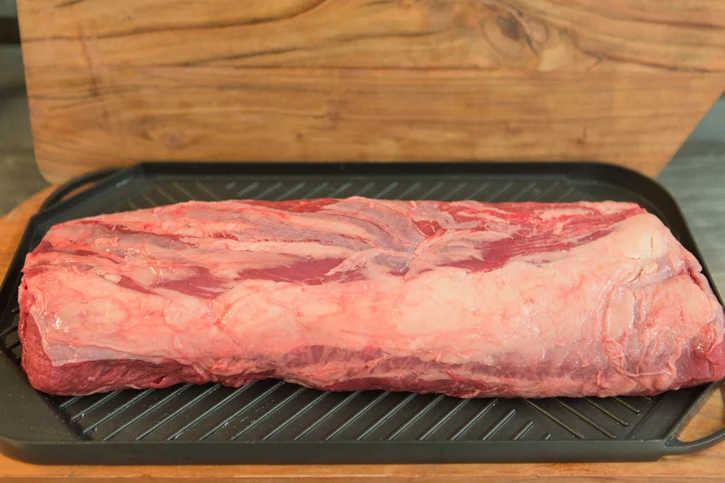
The better buy is whichever format your kitchen can turn into the most saleable portions for the money. Compare the same cut and quality, then account for trimming, preparation time, portion size and what you can do with the offcuts. Two products can differ sharply in price per kilogram and barely differ in cost per serve, or the other way round.
What we mean by each option
A whole cut here means a larger piece your team prepares and portions in-house, such as a whole scotch fillet. Portion-cut steaks arrive cut to an agreed specification; how much trimming is left depends on what that specification says.
For a fair comparison, hold the cut, quality and intended dish steady, and write down the raw portion weight and the finished plate you’re aiming for. If one option comes at a different trim or portion size, record that difference rather than treating the two products as interchangeable.
Work out your usable yield
Usable yield is the share of purchased weight that becomes the product you’re costing. For a raw steak comparison, weigh the trimmed meat that meets your steak specification. For a cooked-serve comparison, measure after the same cooking and resting process. Whichever basis you pick, keep it the same for both options.
The USDA Food Buying Guide draws a useful distinction between food as purchased and its edible portion, and the example below follows the same logic.
A simple raw-weight example
Say a 1 kg piece gives you 800 g of meat that meets your steak specification. Its usable steak yield is 80%. At an illustrative 200 g raw portion, that’s four steaks. A different 1 kg purchase that is fully usable as five 200 g portions gives five. These are made-up weights to show the calculation, not Preston Foods product specifications or a published meat yield.
Keep usable trim separate from waste. If an offcut becomes another menu item, record where it goes and allocate its value consistently, because counting the same trim against two dishes makes both look cheaper than they are. Trim heading into a mince blend is worth tracking properly, and our guide to choosing beef mince for burgers covers how those blends get specified.
Cost the prep bench, not just the invoice
For each option, work out:
Purchase cost for the quantity being tested, on the same GST basis.
Freight or other charges allocated to that quantity.
Preparation time, costed at your own labour rate.
The number of portions that meet your agreed specification.
Any separately recorded credit for usable trim.
Cost per usable raw portion
(Purchase cost + allocated charges + preparation labour – justified trim credit) divided by usable portions.
That covers the meat and its preparation. Add your other ingredients, cooking costs and normal costing allowances when you assess the finished dish. If you’re working in cooked weights, apply cooked yield consistently: dividing a raw purchase weight by a cooked serving weight without accounting for the change will flatter the result.
Which format suits the way your team works?
What to weigh up before ordering
Scroll sideways to compare →
What to weigh up before ordering
Whole cuts may suit you when…
Portion-cut steaks may suit you when…
Your team has the skills and the bench time to trim and portion consistently.
You want more of that preparation done before delivery.
You have a planned use for different-sized pieces and usable trim.
Your menu depends on a defined portion specification.
You want flexibility across specials, functions and other dishes.
Predictable prep matters most during busy service periods.
Record real results across more than one piece or delivery before you set a budget. One unusually tidy cut, or one rushed prep session, is a thin basis for a permanent menu decision.
Bring your portion requirements to the butcher
Tell us the dish, the target raw weight, thickness, trim and quantities you’re working with, and we’ll talk through the butchery and preparation options that make sense for your business. Still choosing the cut? Start with our steak selection guide. Our guide to beef cuts for slow cooking covers yield and preparation labour for braising dishes.
No. It depends on the agreed specification, the purchase cost, your preparation labour and your usable yield. Measure those four in your own kitchen rather than assuming either format wins by default.
Use the basis that matches the decision in front of you. Compare raw steaks on usable raw portions. For a finished cooked serve, measure cooking yield as well, and apply the same method to both options.
Only give trim a value when you genuinely use it and can account for it. Keep waste, usable trim and steak portions in separate lines, and never credit the same trim value to more than one dish.